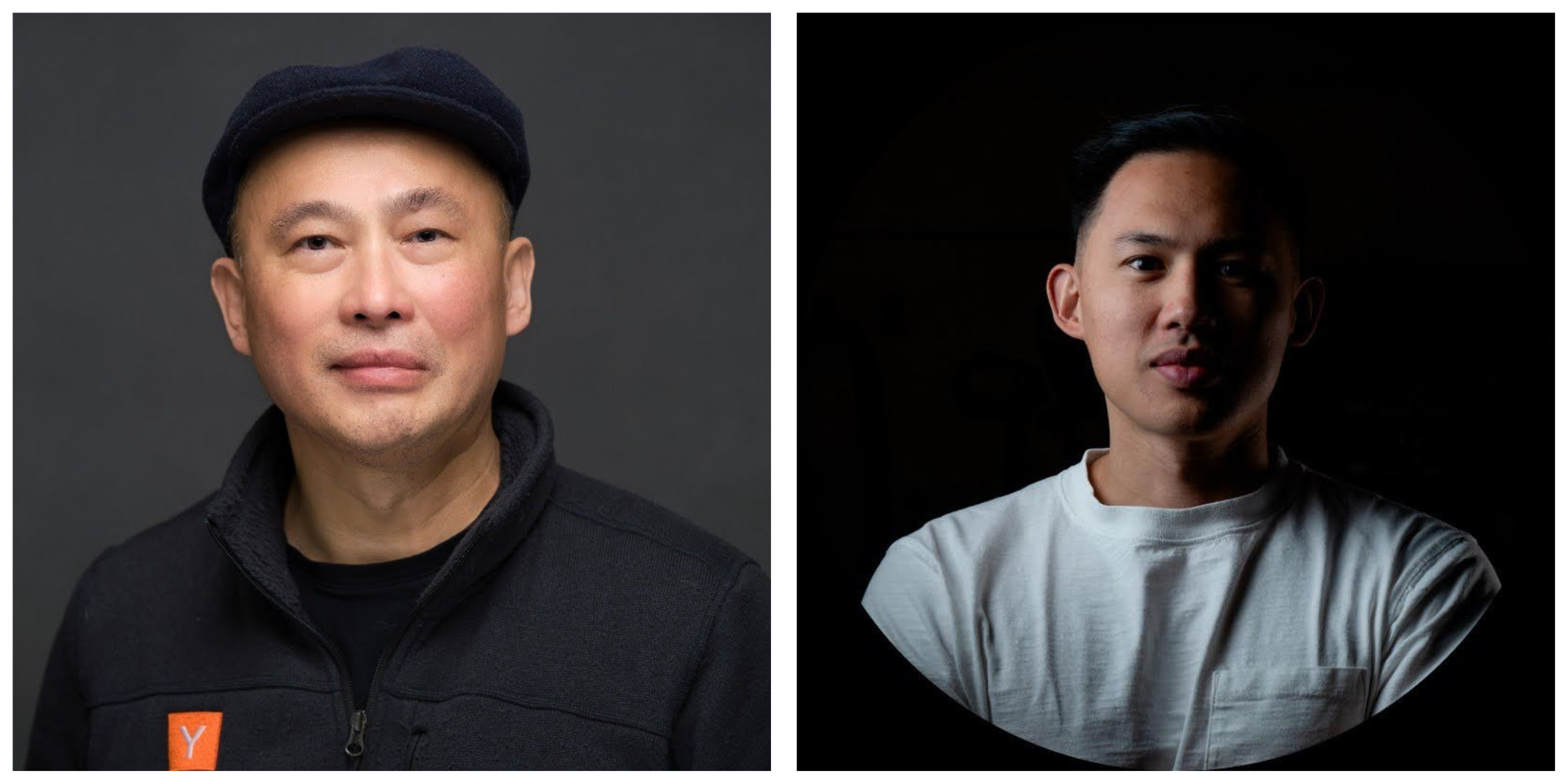
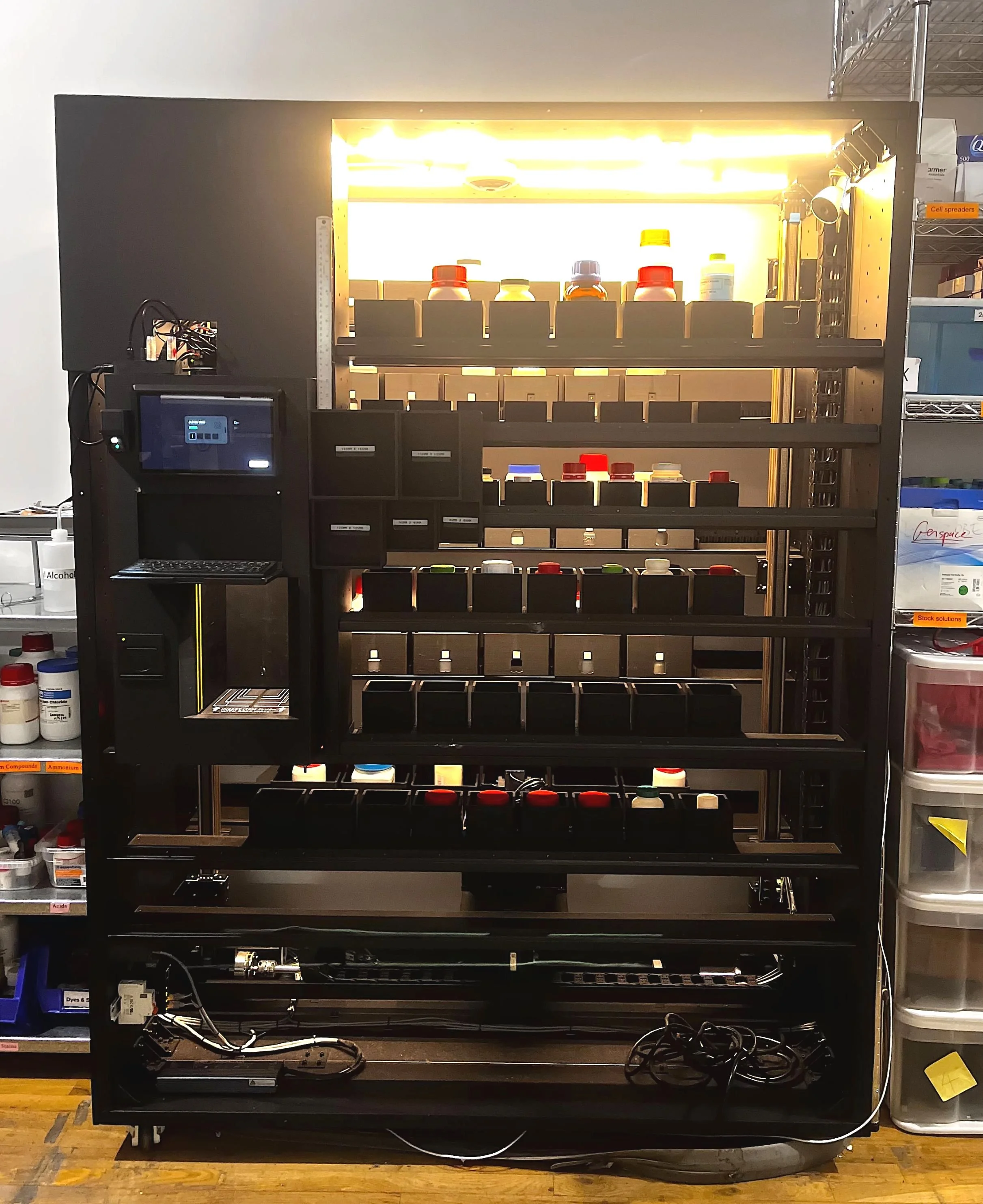
Co-founders Chiu Chau and Sam Chau discuss the latest from Openshelf, which aims to automate physical inventory with open source hardware and software. Openshelf recently beta-launched their first inventory robot (LB2) at Genspace, engaging with our diverse user base to improve the platform while fundamentally shifting how the world’s first community biology laboratory organizes inventory for scientists, artists, founders, and everyone in between.
–
Community labs are places to learn and explore–for everyone. For founders building new tech, having access to such a diverse user base and its diversity of backgrounds, interests, and experimental needs offers an ideal opportunity to stress-test new tools.
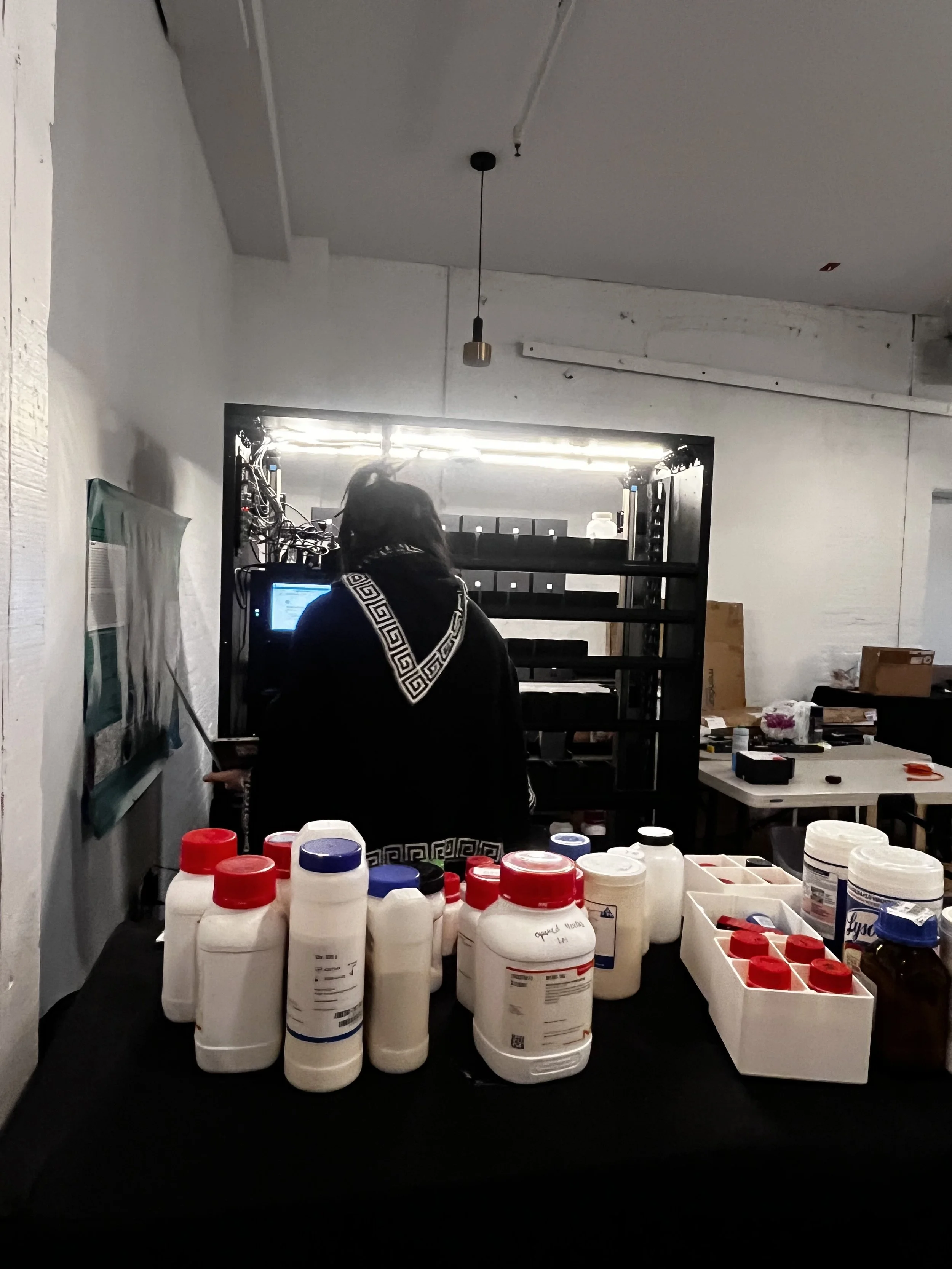
Last fall, Genspace welcomed Openshelf as a new partner in beta-testing the future of laboratory inventory automation. Openshelf’s first prototype–an open-source system designed to automate physical inventory management–is now part of Genspace’s laboratory operations, supporting a shared space used by learners, researchers, and founders with a wide range of materials and workflows.
Openshelf was founded by Chiu Chau, co-founder of Opentrons, a company that began as a project at Genspace in 2012 and later grew into a global manufacturer of affordable liquid-handling robots. While Openshelf is not affiliated with Opentrons as a company, that shared history underscores a broader pattern: community labs continue to play a meaningful role in the early life of new tools for biotechnology.
Genspace Executive Director Casey Lardner sat down with Openshelf co-founders Chiu Chau and Sam Chau to discuss why founders need real-world beta environments, how community labs create productive constraints, and why automation isn’t about replacing humans–but about giving them more space to experiment, iterate, and learn from mistakes.
Casey: To kick things off—how did Openshelf come to be? Where did it start in your brain?
Chiu: After I finished Opentrons, I tried to retire—every year. And then after about 18 months, I realized that didn’t work. I still wanted to build something useful for people, especially in healthcare and life sciences. We started by trying to understand real needs, and inventory kept coming up as a problem. The original goal was pharmacy.
We started building a robot for pharmacies and found out it was too hard. Then we identified a very small market—optometry—and built a robot for that. We had a prototype, went to a conference, and I killed it. The market was too small, and the customers didn’t really understand it, but the fundamentals of this robot carried over to what we’ve built today.
We went back to pharmacies again, built another prototype, and it was way too big. It was overbuilt and overengineered, so after about 12 months,I killed it again. During that time, we started talking to people in labs and realized they had the same need: a lot of inventory, not enough labor, and a complete mess. So we stripped the machine down again, learned from the last two markets, reviewed the existing robot, and started talking to people at Genspace. That’s when we really saw this as an interesting market. That’s how Openshelf became focused on inventory management.
Casey: After Opentrons and all of its success, inventory was still something people kept bringing up as an issue—and you thought, as a roboticist, “I can fix that”?
Chiu: Yep, exactly. I wasn’t fully aware of how big the market was until we dug in more. Sam did a lot of homework on the warehousing problem. If you zoom out, large warehouse machines already exist and cost millions of dollars—Amazon has them. But on a small scale, in labs or pharmacies, they basically don’t exist, people can’t afford them, or they don’t actually solve inventory problems.
Casey: Tell me a little more about the clients you’re talking to now. It sounds like there’s interest from lots of different kinds of labs.
Chiu: There is. That’s actually why Genspace is a perfect beta site—to understand customer and end user needs. Even though you’re not a typical customer, Genspace consists of the perfect users: if the robot works in your space, it can work in almost any lab environment! It’s like designing a car that can only drive from A to B in perfect weather—that’s not useful. This is a very versatile test.
We’re shipping our first paid system to an AI CRO that does custom compounding for drug discovery. They handle thousands of samples. At one point, they had around 400 compounds—now they have closer to 4,000. At that scale, you just can’t manage inventory manually. Our robot is really the only affordable open-sourced solution. Other systems are huge, require entire storage rooms, and are extremely expensive. The cheapest ones are around $80,000 and only store 80 plates.
Sam: Another big differentiator is software. The hardware in existing systems might be new, but the software is decades old and almost impossible to integrate with modern workflows and existing equipment. Our philosophy from the beginning has been open source. The API protects things like motor controls for safety, but otherwise, we want people to use the system however they need. We don’t want to lock anything behind doors. Open usage is what drives product development and community.
Casey: What’s something about building hardware that people underestimate?
Sam: Software is one thing people underestimate. A lot of hardware companies either don’t think enough about software or they overthink it and make it proprietary. We don’t want to build software as a product—we let software people do that, and we focus on what we know.
Another thing people underestimate is how hard hardware is. With software, you can roll back changes. With hardware, you can’t just hit control-Z. You have to understand what broke, fix it, and make sure you didn’t create a new problem. It’s a constant cycle of break it, fix it, test it, and hope it works.
Casey: Can you talk more about the design process? How do you build something that works in a community lab, an academic lab, and a clinical lab?
Chiu: It always comes back to workflow. If you don’t understand how people actually work, you’re just guessing. People say, “Just label everything,” but it’s all the little details that make a system seamless.
When we moved the robot into Genspace, it took ~30 minutes. That’s because we designed it with wheels and modularity. Those details matter. The system is modular—you can upgrade parts without replacing the whole machine. We’re already working on a refrigeration module that can be added later, right in the field.
Casey: Looking ahead, what do well-automated labs look like in ten years?
Chiu: I think automation should streamline execution so humans can focus on designing experiments and making mistakes. A lot of lab processes are already streamlined—PCR, real-time PCR—but the in-between parts aren’t connected yet.
Automation should help move things around and make execution more efficient. But innovation still starts at the bench. Humans are very good at experimenting—including messing things up. A lot of discoveries happen because someone forgot something and came back later and realized it worked. Automation should support that, not replace it.
What excites me about Genspace is that it’s always open. People come in because they’re curious about biology. You don’t need credentials—you can just check it out. That’s the best thing about a community lab.
Casey: Before we wrap, is there anything else you’d want someone to know about Openshelf?
Sam: We talk a lot about labs and pharmacies because that’s our starting point, but you can store almost anything in this system. Anyone dealing with physical inventory has this problem. Keeping it open source lets users ultimately define what it becomes.
–
Chiu Chau is a notable figure in the field of biotechnology and robotics, recognized for his role as a self-employed hacker and co-founder of Opentrons, the biggest open-source laboratory automation company in NYC.
Sam Chau is a robotics and automation executive, known for leading UFACTORY’s U.S. expansion and accelerating the adoption of collaborative robotics.