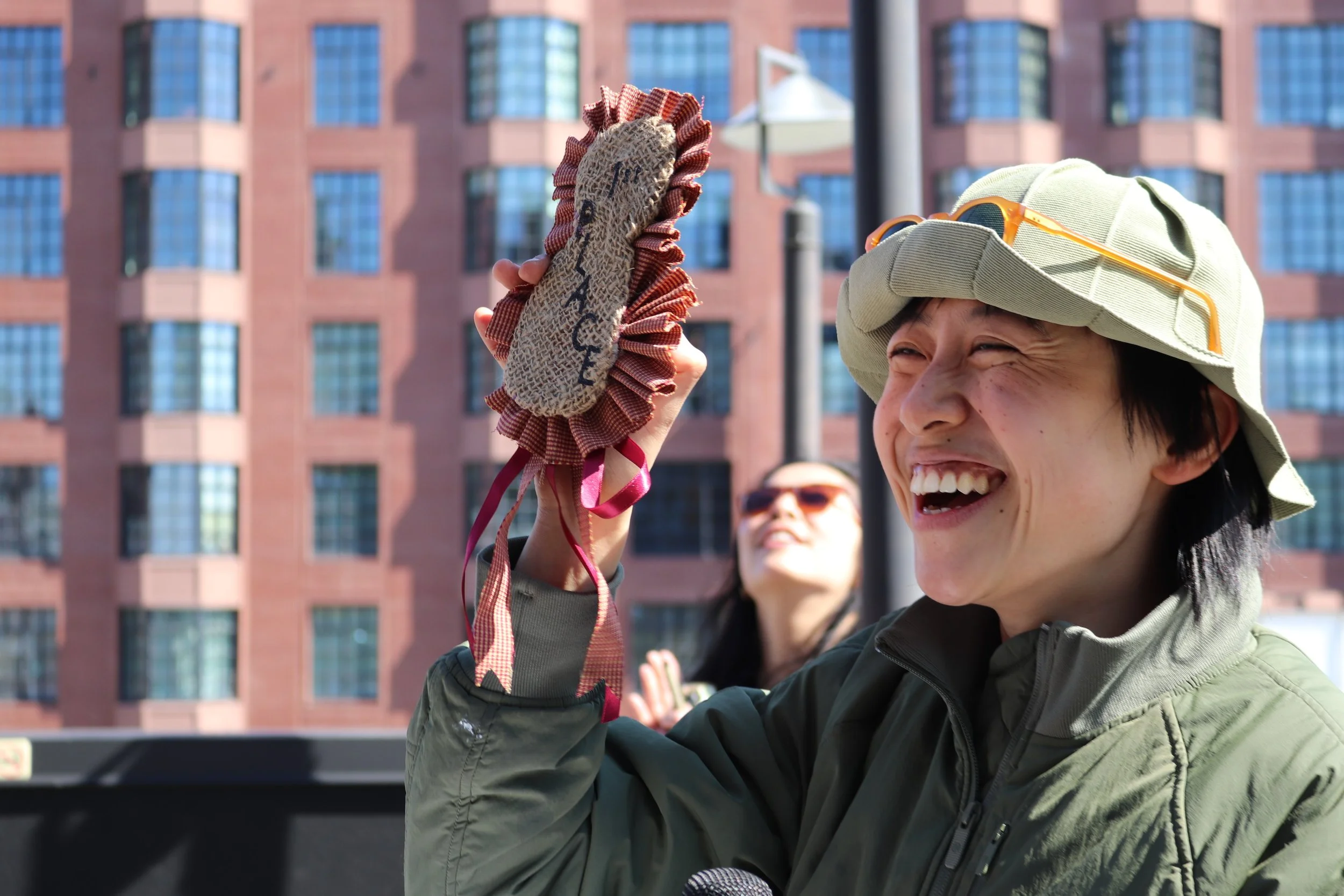
Caroline holding up the prize badge that she hand made for the peanut eating contest on the BRIQ rooftop.
Caroline Chou is a creative scientist, a former Artist in Residence at Genspace, and one of the incubator's current artists. Her practice lives at the intersection of microbial ecology, community, and narrative. She makes work that insists on participation as a form of research.
Ten minutes. One winner.
Two weekends ago, while a workshop on bioluminescence ran and the sixth cohort of Break into Biotech met for the first time, community member Caroline Chou was preparing thousands of boiled peanuts for art and science on Genspace’s rooftop. There were 16 competitors and the winner downed 112 peanuts in just 10 minutes. Sarai Mena, Genspace's Education and Community Outreach Coordinator, sat down with Caroline to find out find out more about the contest, her artistic practice, and her recent and upcoming work.
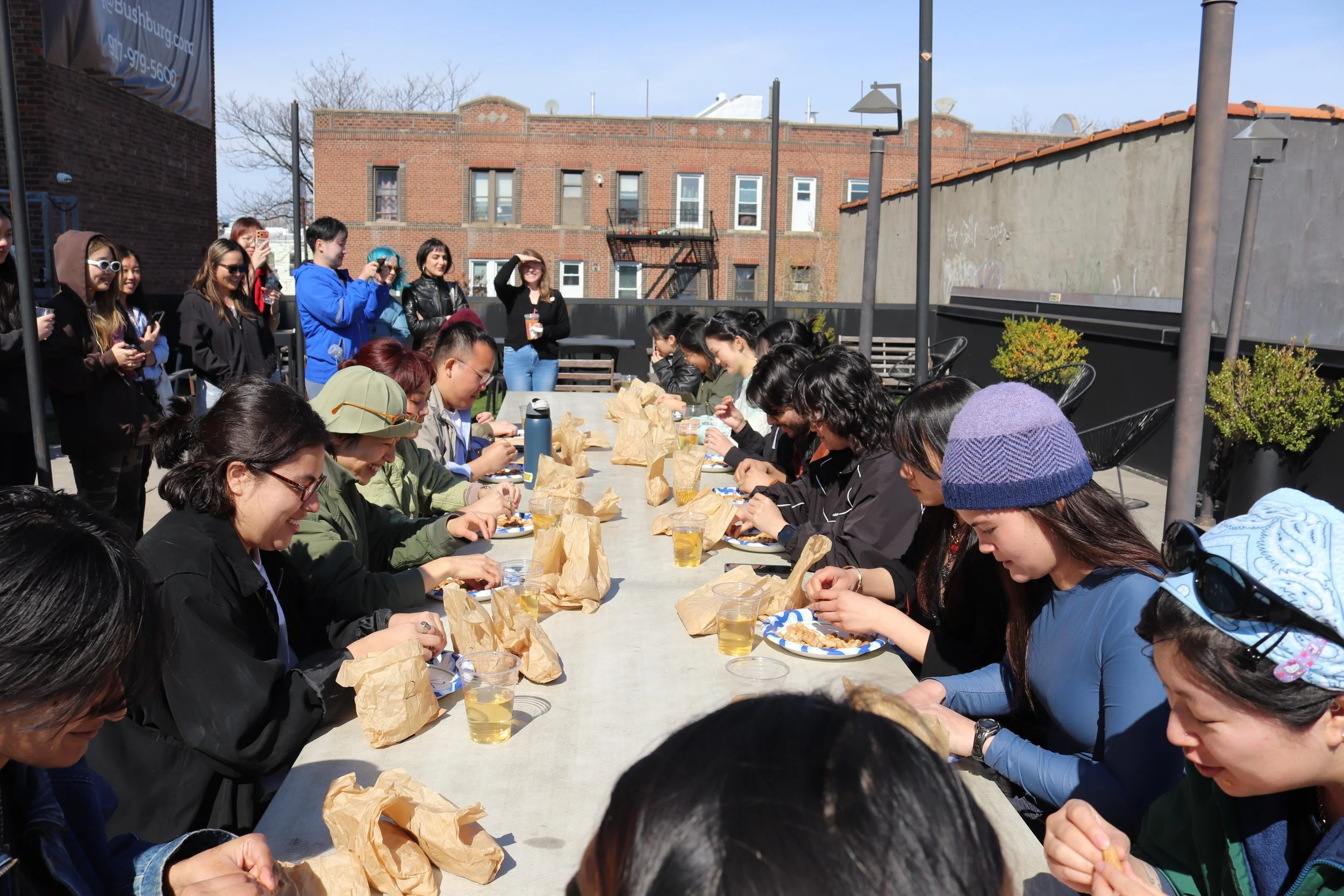
Competitors beginning to de shell their peantuts. Spectators are cheering on the sidelines.
Sarai : Let's start at the beginning. How did your peanut eating contest come to be?
Caroline: My original idea was just a quiet gathering — tea, snacks, very chill. But when I brought it up during one of our weekly cohort check-ins, someone suggested a contest and there was just so much enthusiasm. I got really excited too. So honestly, it emerged from the brainstorming of the whole GBS cohort. It was very much a group effort from the start.
SM: And peanuts specifically, where did that come from?
CC: I'd spent time in Taiwan with family, eating peanuts before meals with tea. When I came back home I wanted those peanuts again, so I started boiling them myself. Over time, there was just this accumulation of shells. And then the idea of turning that into a piece followed naturally.
SM: You boiled over 10 kilos of peanuts for this. What was that process like?
CC: I have two Instant Pots. I boiled them for about an hour and twenty minutes each, with soy sauce and star anise. Once one finished I'd just throw in the next batch. My favorite part was when the water was still hot and you'd drop new shells in and they'd sizzle. That was very satisfying. The smell was both overwhelming and really comforting. Very umami. It filled the whole house. I also invited a friend over to hang out while I did it, because I was like, "I'm boiling peanuts, please come." So even the making of the material was already becoming a social thing.
SM: Walk us through the piece you're making for the September showcase.
CC: I'm drying and grinding the shells, then mixing in methyl cellulose, water, and cornstarch to make a really sturdy, clay-like material. My goal right now is making something I can actually sculpt with. And because I'm gathering so many shells, I want it to be a big piece. Human-sized, life-sized. Something where a person stands next to it and it's genuinely substantial. The piece is still taking shape, but thematically it's about traditions that continue, and traditions that transform. Eating boiled peanuts with family between meals is a habit that's common in Chinese and Taiwanese households, and other cultures too. It touches on diaspora, on gatherings, on continuation. Those themes were also present in my previous piece with the cordyceps project, so there's a thread I'm trying to keep going.
SM: The shells that went into this material came from a specific group of people, on a specific afternoon. Does that provenance matter to the work?
CC: It's something I didn't fully anticipate, but yes, it'll be incorporated somehow. These peanuts became an invitation, a gathering, a conversation. And it kept going after the contest. I still had pounds of peanuts left over, so I started bringing them wherever I went. Meetings, events, Washington Square Park. I'd set up a bowl and just see what happened. One afternoon, a man sat next to me and I offered him some. When he cracked one open he was genuinely surprised. He said he'd had boiled peanuts before, but only in his mom's homeland, which was Zimbabwe. We ended up spending the whole afternoon together. He was just an older man from Long Island having a day off, eating peanuts with me in the park. It was really sweet. That kind of thing — a smell, a taste triggering a memory, that's the research. You don’t usually get that from a survey.
SM:Food keeps showing up in your work. Your last piece involved feeding people soup, and now this. Is that intentional?
CC: Honestly, it was never the intention, and that's what makes it interesting to reflect on. The peanuts were a means to an end, to get the shells. But feeding people and cooking for people is something I've always loved. I used to work in community health organizing, and something I learned that came from the Farm Workers Movement was where organizers would say, if you want to bring different people together, just have a meal. That always stuck with me.
SM: Food does something a formal setting can't. It just brings the conversation forward.
Can you tell us a bit about some of your previous work? I’ve been thinking a lot about the cordyceps piece at last years exhibit and Microbes! The Musical
CC: The cordyceps piece was a really fun piece where I was starting to experiment with form and structure. The themes were about being and becoming — the cordyceps fungus and the ant, where the fungus is becoming its fruiting self through the ant, and the ant is being an ant but also transformed into a hybrid creature. And light was part of it too, the shadow and the body getting projected, so something is within but becomes something else when the shadow is emitted. They’re both being and becoming at the same time. A lot of my thinking is also influenced by Daoism and the being of becoming, where one can’t exist without the other, like yin and yang.
had a lot of fun using bioplastics in that piece. I was using it as a kind of glue or adhesive — I had plastic and I had wool, and it’s so hard to blend the synthetic and the natural together without it looking really stark or unnatural. So I decided last minute to incorporate the bioplastic as a transition point between the two. And now with the peanut shells, it’s about using the material to help with the storytelling. There’s a thread I’m trying to keep from one piece to the next.
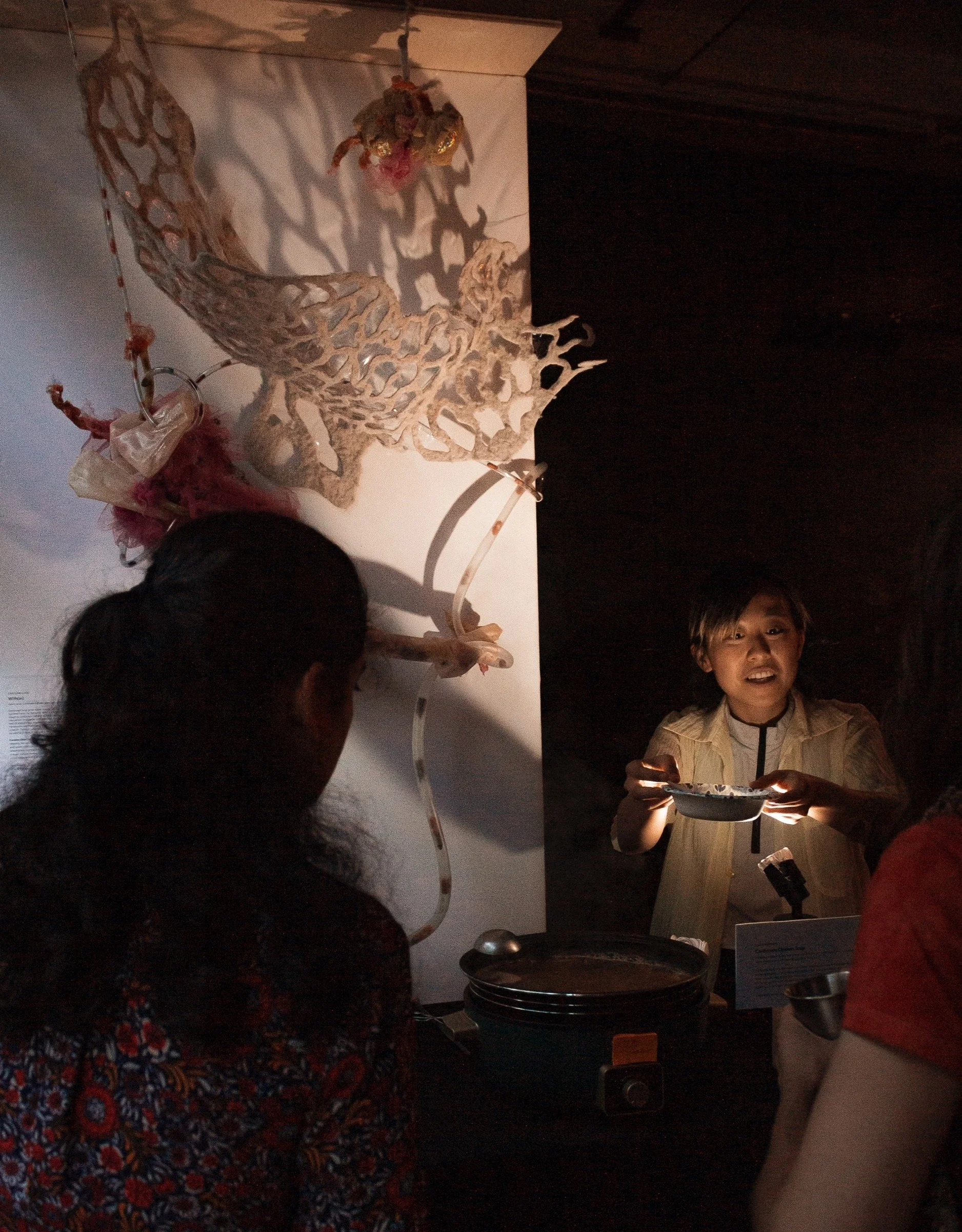
Caroline serving people mushroom soup next to her sculpture at last years Biomaterials Studio Exhibit
SM: Can you tell us about Microbes! The Musical? That felt like such a participatory project too.
CC: It was really special. It was part of my thesis in grad school, where one big thing I wanted to do was bring science out of academia and make research accessible to the public. I chose musical theater, a genre I’m not familiar with, knowing that there’s not much overlap between science and theater, so it would be an opportune place to bring science into a world that doesn’t typically get exposed to it. The main goal was just sharing the wonders of microbes with people.
What was really fun was that the actors, choreographers, and dancers who came on didn’t know much about bacteria and fungi. So I was also offering some education by sharing the backstory of the characters , and they learned how important bacteria and fungi are to the world. Versus how they came in, not quite sure of the difference between a bacteria and a fungi.
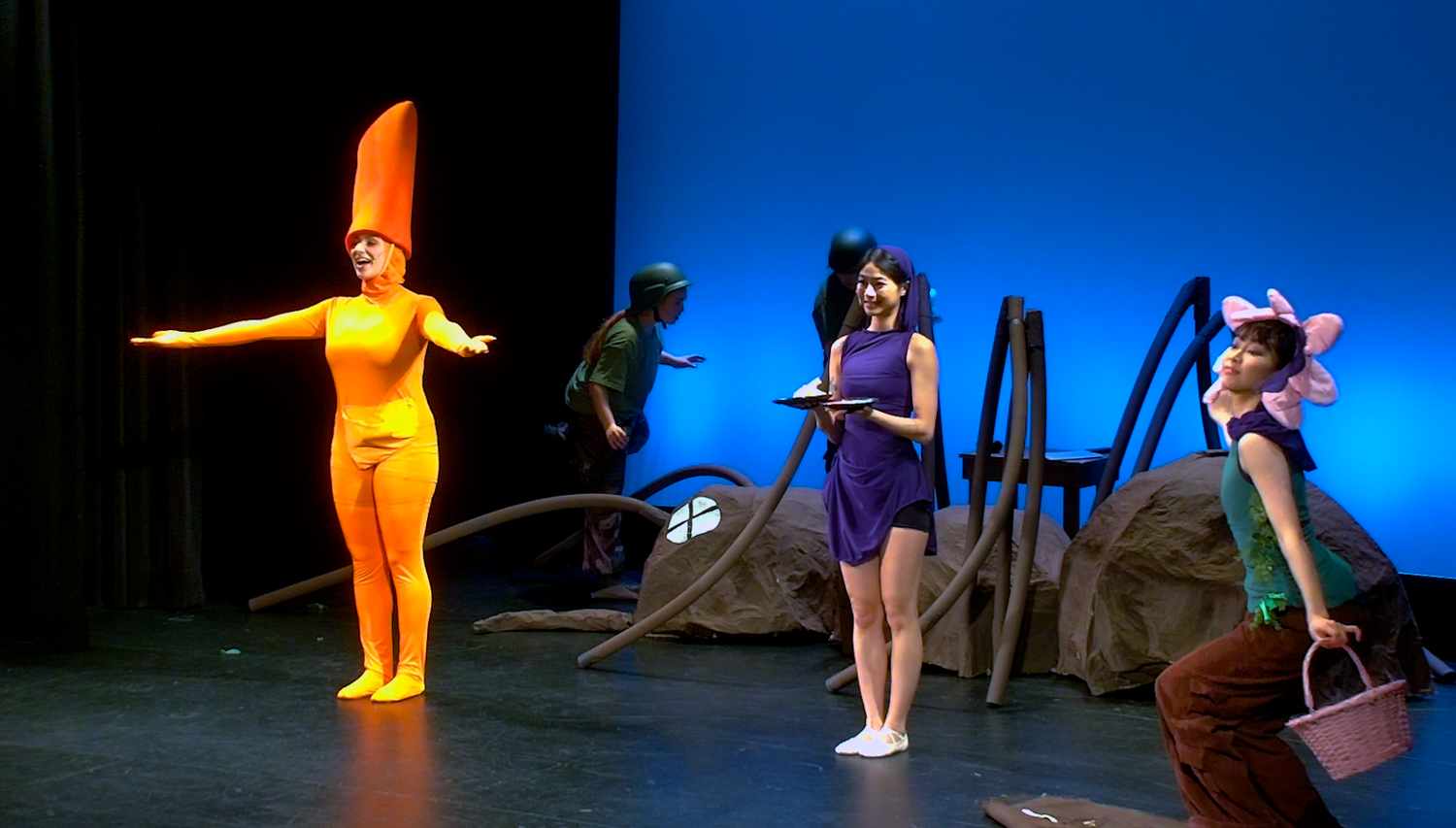
Image from Microbes! The Musical, Caroline’s graduate thesis.
SM: A lot of scientific research happens behind closed doors, but your process seems to insist on the opposite. Do you think collective participation is the research — and is that a future you're trying to create?
CC: For me, yes. When I was working in public health, we were doing a health intervention with high school students. Their experience was the data- what they felt, what they learned. That was the research. And I think that made a lasting impression on me, because laboratory research can feel very one-sided. When you put something more organic out into a community setting, the information still comes. You might actually learn more. And then I'm thinking about how this is also science communication, not just content made about science, but participation as communication. People at that peanut eating contest wouldn't have heard about biomaterials if it weren't for that afternoon. That educator part of me just comes out when I'm bringing peanuts around.
SM: What's the most surprising thing that's come out of using food as a medium?
CC: How memorable it is. An artist who came for a talk said, "I remember you because of the soup." And I thought, oh, that's interesting. You don't see a lot of food in art settings. You're definitely not supposed to see it in science spaces. But somehow that disruption is what makes it land. It feels natural, even when it probably shouldn't.
Caroline Chou is a creative scientist with a multidisciplinary artistic practice centered on fungi-insect relations. Not bound to a particular medium, Caroline’s work is driven by interdisciplinary research and rooted in microbial ecologies and narrative. Inspired by the replenishing and interconnected relationships microbes have with the world around them, she aims to make science accessible through multiple senses and bring community, scientists, and systems of power together in conversation with one another.